
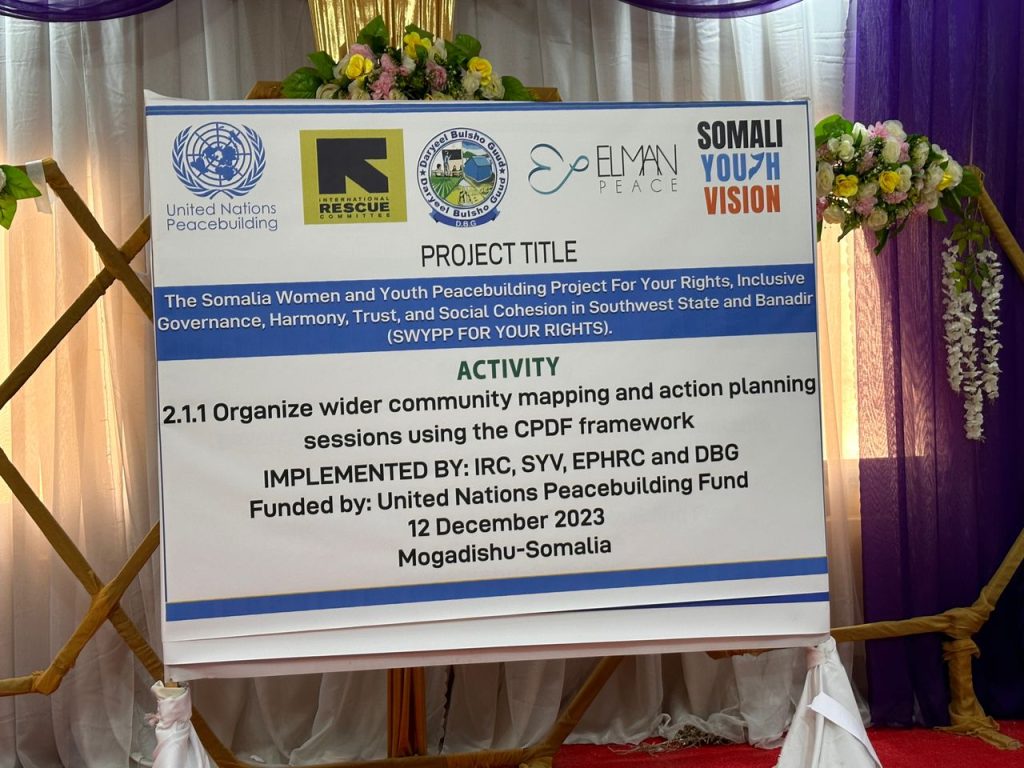
The DBG project team conducted a one-day workshop session for Hawl-Wadaag community mapping and action planning in Maka-Al-Mukarama hotel on the 12th of December 2023. Generally, the workshop served to organize a wider community mapping and action planning session using the Community Peace and Development Framework (CPDF), including locally defined indicators of peace and good governance. A total of 60 participants attended the workshop drawn from community members and local leaders. More specifically, the workshop aimed at conducting a participatory mapping process with multiple stakeholders within the community to measure core governance and peacebuilding indicators, and to provide a platform for community members and local leaders to work together to constructively address concerns about the quality of peace, governance, and development within their communities. The workshop was conducted by an experienced facilitator who confirmed that the participants understood the questions and issues involved. The facilitator also engaged with participants in discussions and community scoring exercise.
Methodology of the workshop
The facilitator conducted a participatory mapping process with multiple stakeholders within a community to measure core governance and peacebuilding indicators. Presentation sessions were employed on CPDF, tools, and community-specific action plans.
The following methods were used:
- Presentation Session: PowerPoint slides were employed and explained the CPDF tools, and community-specific action plan.
- Community mapping and action planning session: participants were divided into two communities. Each community conducted community mapping and community action plans separately.
The workshop sessions
The workshop began with self-introduction of the participants, setting the ground rules for the workshop followed by a presentation on workshop aims and objectives. In this session, the project team presented CPDF models that included domains and sub-domains such as services and resources, equality and inclusion, accountability, economic opportunity, and social cohesion. A community scoring workshop, a CPDF matrix, and the development of CPDF action plans were presented.
In the community scoring sessions, each community was set apart and provided with a platform for community members and local leaders to work together to constructively raise concerns about the quality of peace, governance, and general development within their respective communities. Each community participant was asked domain and sub-domain questions. At the end of the sessions, each community developed community peace implementation action plans based on findings from CPDF and community discussions and addressed low-performing domains.
Session outcomes
The workshop sessions achieved the following outcomes through presentations, CPDF tools, community mapping, and action plans.
- Participants increased their awareness and civic engagement on conflicts, emphasizing those that are land and resource related where possible.
- Used the CPDF tool for multiple stakeholders to identify conditions for peace and development at the community level.
- Participants identified conflict triggers at the community levels.
- Participants promoted social cohesion through the identification of joint values and concerns.
Conclusion
The one-day workshop in Hawl-Wadaag proved successful in utilizing the Community Peace and Development Framework (CPDF) to engage community members and local leaders in constructive dialogue and action planning. The workshop achieved notable outcomes, including:
- Increased awareness and civic engagement: Participants gained a deeper understanding of conflict dynamics, particularly those related to land and resources, prompting increased civic engagement and potential conflict mitigation efforts.
- Utilizing the CPDF tool: The workshop effectively employed the CPDF to identify key conditions for peace and development within the community, allowing for a multi-stakeholder approach to problem-solving.
- Identifying conflict triggers: Participants actively identified specific triggers for conflict at the community level, paving the way for targeted interventions to address these root causes.
- Promoting social cohesion: By acknowledging shared values and concerns, the workshop fostered a sense of unity and collaboration within the community, strengthening social cohesion and laying the groundwork for future collective action